


Professional Affairs

Phlebotomy Service Specification and Standard
The "Phlebotomy Service Specification and Standard" was developed in 2021 by the Secretariat of the Strategic Council for Developing Health Guidelines, in collaboration with Tehran University of Medical Sciences, the Scientific Association of Traditional Persian Medicine, the Board of Examiners for the Traditional Medicine Specialty, and the Persian Medicine and Complementary Medicine Office of the Ministry of Health.
Main Content of the Document:
1. Definition of Phlebotomy:
Phlebotomy is a therapeutic method in Persian Medicine involving an incision on a vein or artery to withdraw blood, aiding in the treatment or prevention of specific diseases. Its primary distinction from cupping (Hijama) and leech therapy lies in the depth of blood withdrawal and the precise control over the quantity of blood removed.
2. Conditions and Implementation Protocol:
-
Before Phlebotomy: Patient assessment (pulse, blood pressure, coagulation tests), avoidance of heavy meals, and evaluation of contraindications.
-
During Phlebotomy: Disinfection of the site, monitoring the patient's pulse, and adjusting the volume of blood withdrawn based on the patient's condition.
-
After Phlebotomy: Dressing the site with honey or turmeric, avoiding strenuous activity, and consuming nourishing foods such as honey water and tender meat.
3. Indications:
-
Diseases caused by hyperemia or blood disorders (blood thickening/plethora, joint pain, skin eruptions).
-
Prevention of sanguineous (demavi) diseases in spring.
-
Certain cardiac, metabolic, and gynecological conditions (such as Polycystic Ovary Syndrome).
4. Contraindications:
-
Coagulation disorders, pregnancy, individuals under 14 years and over 60 years (except in essential circumstances).
-
Patients with severe weakness, cold-temperament (cold Mizaj) disorders, or following a hot bath or sexual intercourse.
5. Required Equipment and Environment:
-
Requires a sterile room with controlled temperature (23-25°C), adequate lighting, and single-use disposable items (scalpel blade, sterile gauze, blood collection container).
-
The service may only be provided by specialized physicians in Traditional Medicine (holding a Ph.D.).
6. Patient Education:
-
Avoiding sleep for up to 6 hours after phlebotomy.
-
Refraining from consuming cold and salty foods for up to 24 hours.
-
Abstaining from strenuous activity.
-
The complete file of the "Blood Phlebotomy Standard" is available for download at the bottom of this page (below the dashed line).
 ادمین انجمن علمی طب سنتی ایران

Leech Therapy Service Standard
The "Leech Therapy Service Standard" was developed in 2021 by the Secretariat of the Strategic Council for Developing Health Guidelines, in collaboration with Tehran University of Medical Sciences, the Scientific Association of Traditional Persian Medicine, and the Persian Medicine and Complementary Medicine Office of the Ministry of Health. This standard specifically addresses leech therapy (Hirudotherapy) as a therapeutic method in Traditional Persian Medicine and encompasses the following topics:
1. Definition and Applications of Leech Therapy
A method for blood purification and disease treatment using medicinal leeches.
Applications in treating conditions such as post-surgical hematoma, varicose veins, diabetic foot ulcers, joint pain, infertility, and coagulation disorders.
2. Characteristics of Suitable and Prohibited Leeches
-
Suitable Leeches: Hirudo medicinalis with specific physical characteristics (olive-green color, yellow stripes on the dorsum).
-
Toxic and Prohibited Leeches: Leeches with variable colors, those grown in polluted waters, or those with blue stripes.
3. Considerations Before, During, and After Treatment
-
Before Treatment: Avoidance of heavy meals, assessment of patient's condition (absence of coagulation disorders, severe anemia, pregnancy).
-
During Treatment: Control of blood loss volume, prevention of infection, and monitoring for allergic reactions.
-
After Treatment: Avoiding sleep for up to 6 hours, consuming light meals, and refraining from strenuous activities.
4. Indications and Contraindications
-
Indications: Tissue grafting, skin diseases (eczema, psoriasis), gastrointestinal issues (gastric ulcers), and inflammatory diseases.
-
Contraindications: Patients with coagulation disorders (hemophilia), those taking anticoagulant medications, pregnant women (except in essential cases).
5. Implementation Standards
-
Physical Environment: A room with a temperature of 23-25°C, washable surfaces, and equipped with proper ventilation.
-
Equipment: Glass containers for holding leeches, sterile instruments, and resuscitation facilities.
-
Practitioner Qualifications: Only specialized physicians in Traditional Persian Medicine (holding a Ph.D.) are authorized to prescribe and perform leech therapy.
The complete file of the "Leech Therapy Standard" is available for download at the bottom of this page (below the dashed line).
ادمین انجمن علمی طب سنتی ایران

Enema Service Specification and Standard
The "Enema Service Specification and Standard" was developed in 2021 by the Secretariat of the Strategic Council for Developing Health Guidelines, in collaboration with Tehran University of Medical Sciences, the Scientific Association of Traditional Persian Medicine, the Board of Examiners for the Traditional Medicine Specialty, and the Persian Medicine and Complementary Medicine Office of the Ministry of Health. This guide provides precise and scientific standards for enema therapy in Traditional Persian Medicine.
Key Content:
Definition and Applications:
Enema therapy involves introducing medicated liquids into the rectum or uterus for therapeutic purposes. This method is used in the treatment of gastrointestinal diseases (such as constipation, colitis), inflammatory conditions, kidney and uterine disorders, and even certain systemic conditions like hypertension and poisoning.
Procedure and Implementation Steps:
-
Patient assessment prior to performing the enema (evaluating heart, liver, and brain health).
-
Preparation of herbal medicines and control of the enema fluid's temperature and concentration.
-
Correct technique for performing the procedure and appropriate patient positions (such as lying on the side or in the prostrate position).
-
Post-procedure care (rest, consumption of strengthening syrups, and avoiding exposure to drafts).
Implementation Standards:
-
Physical Environment Conditions: Temperature, lighting, ventilation, and essential equipment (such as an examination table and enema device).
-
Practitioner Qualifications: Only specialists in Traditional Persian Medicine (holding a Ph.D.) or trained physicians under their supervision are authorized.
-
Consumable Supplies: Disposable sheets, sterile gloves, and herbal medicines (such as rose and honey).
Indications and Contraindications:
-
Indications for Prescription: Intestinal diseases, joint pain, uterine problems, and certain neurological disorders.
-
Precautions or Contraindications: Allergy to herbal medicines, bleeding hemorrhoids, and acute cardiac diseases.
Educational Recommendations for Patients:
-
Avoid performing enemas independently and consult a specialist in Traditional Persian Medicine.
-
Control the temperature of the enema fluid to prevent burns.
-
Immediately report any complications such as dizziness or shortness of breath to the physician.
The complete file of the "Enema Standard" is available for download at the bottom of this page (below the dashed line).
ادمین انجمن علمی طب سنتی ایران
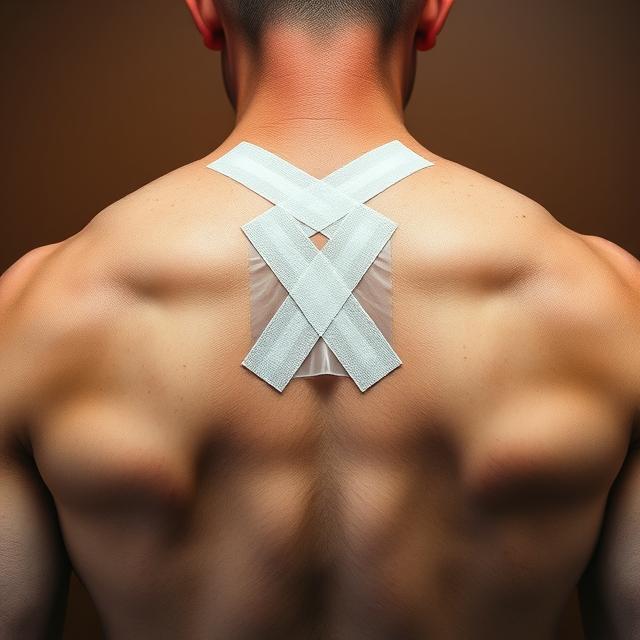
Cupping Service Specification and Standard
The "Cupping Service Specification and Standard" was prepared in 2021 by the Secretariat of the Strategic Council for Developing Health Guidelines, with the participation of Tehran University of Medical Sciences, the Scientific Association of Traditional Persian Medicine, and the Ministry of Health. Key content includes:
-
Precise definition of wet cupping (cupping with scarification)
-
Technical specifications and implementation standards
-
Different anatomical sites for performing cupping and related techniques
-
Requirements before, during, and after performing cupping
-
Indications and contraindications
-
Required equipment and supplies
-
Necessary qualifications for service providers
-
Documentation and record-keeping
-
Potential complications and strategies for their management
-
Educational recommendations for patients
The complete file of the "Cupping Standard" is available for download at the bottom of this page (below the dashed line).
ادمین انجمن علمی طب سنتی ایران

Cupping (Dry Cupping) Service Specification and Standard in Persian Medicine
The "Cupping (Dry Cupping) Service Specification and Standard in Persian Medicine" was developed in 2021 by the Secretariat of the Strategic Council for Developing Health Guidelines, in collaboration with Tehran University of Medical Sciences, the Scientific Association of Traditional Persian Medicine, and the Ministry of Health.
Key Content Includes:
Definition of the Service: Dry cupping is a therapeutic method that involves creating suction on the skin without blood withdrawal. It is performed in two forms: cold and warm.
Equipment: Cupping glasses (cups), suction device, forceps, and an examination table with standard technical specifications.
Authorized Practitioners: Specialist physicians in Traditional Persian Medicine, trained physicians, and trained paramedical professionals.
Indications: Muscle pain, respiratory diseases, dysmenorrhea, and high blood pressure (based on scientific evidence).
Contraindications: Acute inflammation, pregnancy, local infection, and coagulation disorders.
Patient Education: Recommendations before and after cupping, such as avoiding cold foods and refraining from immediate bathing.
Physical Environment: A room with a temperature of 23-25°C, adequate lighting, and washable walls.
The complete file of the "Cupping Service Standard" is available for download at the bottom of this page (below the dashed line)
ادمین انجمن علمی طب سنتی ایران

Steam Therapy and Medicated Steam Therapy (Inhalation) Service Specification and Standard in Persian Medicine
The "Steam Therapy and Medicated Steam Therapy (Inhalation) Service Specification and Standard in Persian Medicine" was prepared in 2021 by the Secretariat of the Strategic Council for Developing Health Guidelines, in collaboration with Tehran University of Medical Sciences, the Scientific Association of Traditional Persian Medicine, and the Persian Medicine and Complementary Medicine Office of the Ministry of Health.
Main Content Includes:
Definition of Services: Steam therapy (using smoke or vapor from plants) and medicated steam therapy (steam from hot water or herbal decoction).
Procedures: Assessment before, during, and after treatment; management of complications.
Qualifications: Provided by specialists in Traditional Persian Medicine, trained physicians, and trained paramedical professionals.
Indications: Respiratory diseases, skin conditions, neurological disorders, infections, and increasing breast milk supply.
Contraindications: Allergy to plants, acute inflammations, dominance of hot or dry temperaments (Mizaj).
Equipment and Environment: Standards for the physical space, required equipment such as steam devices and braziers.
Scientific References: Support for the effectiveness of the methods is provided by citing domestic and international research.
This guide is designed for use in clinics, health institutes (wellness centers), and hospital departments.
The complete file of the guide is available for download at the bottom of this page (below the dashed line).
ادمین انجمن علمی طب سنتی ایران
New Directive on the Issuance and Renewal of Licenses to Operate for Physicians with an Emphasis on Continuing Education on Youthful Population
The "New Directive on the Issuance and Renewal of Licenses to Operate for Physicians with an Emphasis on Continuing Education on Youthful Population" was issued in 2025 by the Medical and Specialized Education Council of the Ministry of Health. In accordance with Clause (23) of the resolutions of the third session of the Central Headquarters for Coordinating Youthful Population, the issuance and renewal of licenses to operate for individuals subject to the Continuing Education Law (including General Practitioners, Gynecologists, Midwives, and other target groups) is conditional upon obtaining at least 5 credit points out of the required 25 annual credit points by participating in continuing education programs on the following topics:
-
Youthful Population
-
Prevention of Abortion
-
Preservation of Fetal Life
Continuing Education Centers are obligated to design and implement educational programs in this regard. Furthermore, experts responsible for issuing certificates and licenses to operate must strictly adhere to this directive.
The complete file of the directive is available for download at the bottom of this page (below the dashed line).
ادمین انجمن علمی طب سنتی ایران
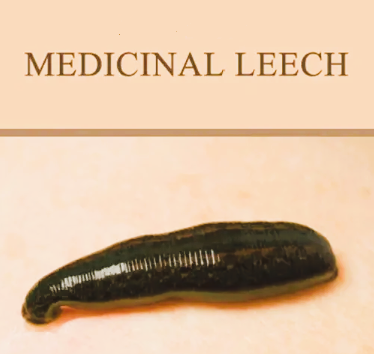
Directive on the Distribution and Supply of Medicinal Leeches (Food and Drug Organization, 2023)
Summary of the Directive (Download the full file at the bottom of the page):
1. Authorization and Conditions for Use
The use of medicinal leeches is permitted only with authorization from the Food and Drug Organization and an authenticity label.
Administration must be carried out in healthcare centers and health institutes (wellness centers) under the supervision of the Ministry of Health.
2. Methods for Disposing of Used Leeches
-
Use of 70% alcohol
-
Freezing at -20°C
3. Approved Leech Species
The only permissible species for use is Hirudo orientalis (Persian Leech).
4. Handling of Violations
Any use of leeches without authorization or obtained outside the legal distribution network will be subject to legal action.
5. Responsibility for Supervision and Revision
The Food and Drug Organization is the sole authority for issuing permits and determining regulations. Any changes in the production and distribution process must be announced by this organization.
This directive is mandatory for physicians, specialists in Traditional Persian Medicine, and healthcare centers.
The complete file of the directive is available for download at the bottom of this page (below the dashed line).
ادمین انجمن علمی طب سنتی ایران
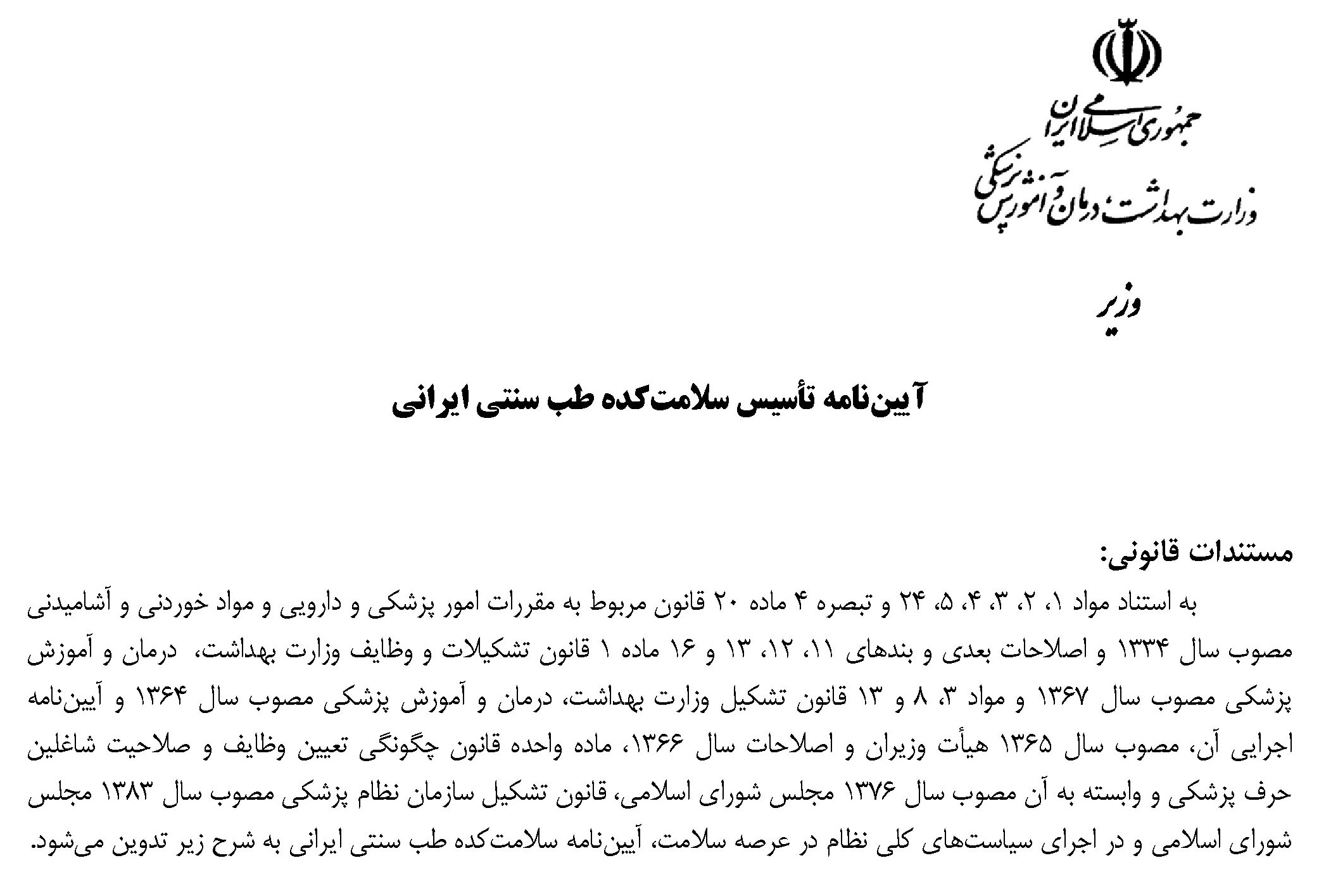
Summary of the Regulation for the Establishment of Health Institutes (Wellness Centers) (+ Download Full File)
1. General Provisions and Legal Documentation:
This regulation was developed in 2012 by the Ministry of Health and Medical Education, based on laws related to medical and pharmaceutical affairs (passed in 1955 and subsequent amendments) and the law establishing the Ministry of Health (1985). Its objective is to organize the activities of Persian Medicine health institutes (wellness centers) and to provide services based on the principles of this medicine.
2. Key Definitions:
-
Health Institute (Wellness Center): An institution that provides Persian Medicine services, including health preservation measures (Tadabir), manual methods (such as cupping and phlebotomy), and pharmacological treatments.
-
Legal Licenses: Includes an operating license and a technical manager license, issued by the University Deputy of Treatment Affairs.
3. Conditions for Applicants Seeking Establishment:
-
Natural Persons (Individuals): Must include at least one physician among the founders.
-
Legal Entities (e.g., Schools of Traditional Persian Medicine): May also apply, subject to compliance with the regulations.
4. Stages of Establishment and Operation:
-
Submitting an application to the University Deputy of Treatment Affairs.
-
Obtaining Initial Approval, followed by an Operating License.
-
Compliance with standards for space, equipment, and personnel before commencing activities.
5. Personnel Regulations:
-
The Technical Manager must hold a specialized degree in Traditional Persian Medicine.
-
The presence of physicians, trained nurses, and administrative staff is mandatory.
-
Personnel must not be concurrently employed at other centers.
6. Structural and Equipment Regulations:
-
Minimum physical space of 120 square meters with separate sections (examination room, cupping room, resuscitation room, etc.).
-
Compliance with health principles (washable floors and walls, waste disposal system, etc.).
-
A Persian Medicine pharmacy (if required) with a minimum dedicated space of 24 square meters.
7. Licensing and Supervision:
-
The Operating License is issued for a period of 5 years, and its renewal is contingent upon compliance with regulations.
-
Supervision of health institutes (wellness centers) is the responsibility of the University Deputy of Treatment Affairs.
8. Violations and Penalties:
-
Providing services without a license or violating the regulations is subject to legal penalties and closure of the center.
-
Misleading advertising or the use of unauthorized titles is prohibited.
The complete file of the regulation is available for download at the bottom of this page (below the dashed line).
ادمین انجمن علمی طب سنتی ایران
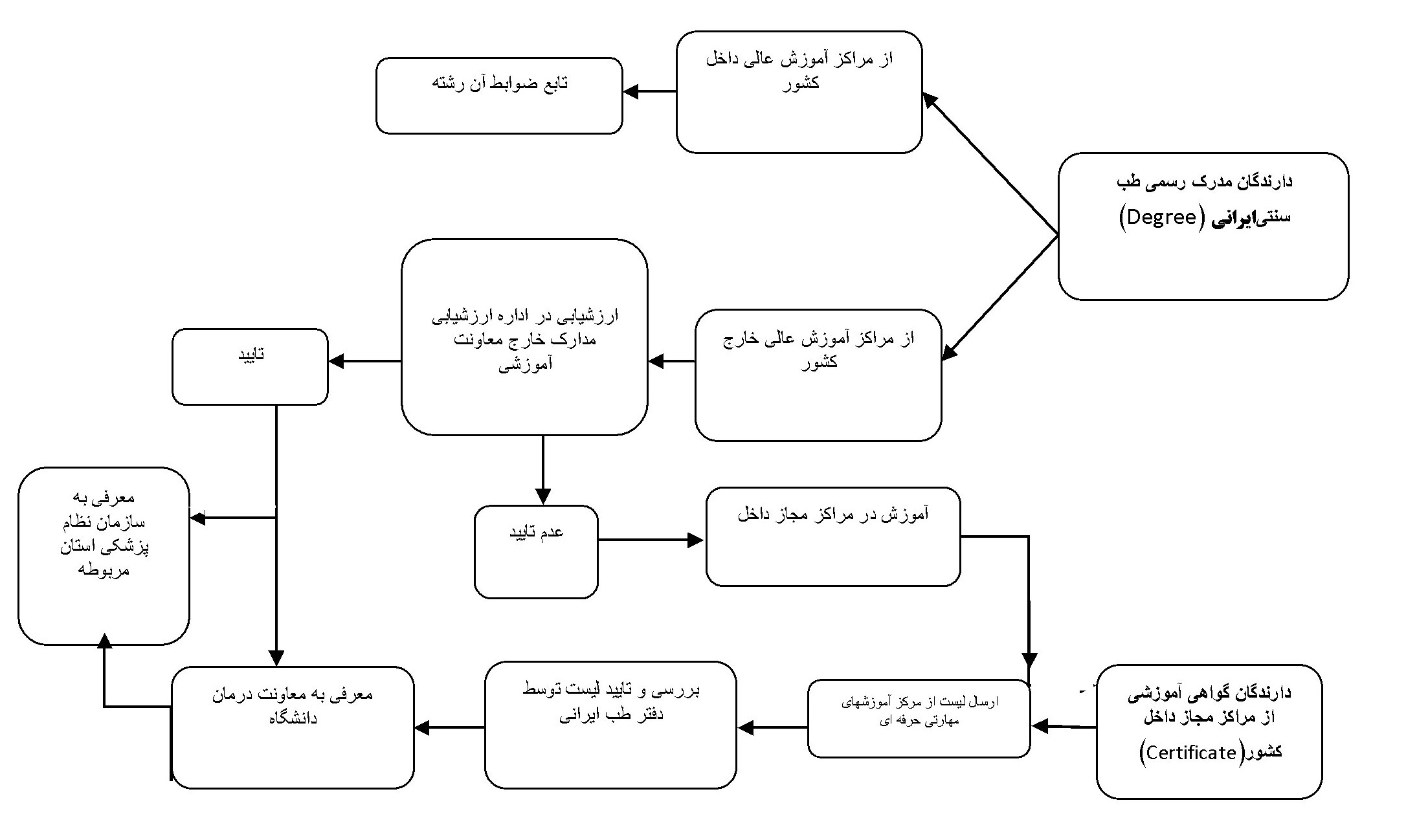
Regulation on the Activities of Practitioners in the Field of Traditional Medicine and the Sale of Medicinal Herbs
The "Regulation on the Activities of Practitioners in the Field of Traditional Medicine and the Sale of Medicinal Herbs" was approved in 2017 by the Ministry of Health and Medical Education of Iran. Its key content includes:
Definitions and Scope of Practice:
-
Definition of Traditional Persian Medicine (Persian Medicine) and related disciplines such as Traditional Persian Massage, natural products, etc.
-
Separation of duties and responsibilities among Persian Hakims (Traditional Physicians), specialists in Traditional Persian Medicine, herbalists (Attari), and other medical groups.
Training and Licensing:
-
Formal academic programs and short-term courses for specialists and Persian Hakims.
-
Emphasis on the necessity of training in authorized centers and the evaluation of foreign degrees by the Ministry of Health.
Conditions for Practice:
-
Persian Hakims must practice under the supervision of specialists in Traditional Persian Medicine within health institutes (wellness centers) or medical centers.
-
Herbalists (Attari) are only permitted to sell standard medicinal herbs, and any form of medical intervention is prohibited.
Violations and Supervision:
-
Legal action against unauthorized activities and violations, such as the supply of herbal medicines without a license.
-
Supervision of the implementation of this regulation by the Ministry of Health and relevant organizations.
The complete file of the regulation is available for download at the bottom of this page (below the dashed line).
ادمین انجمن علمی طب سنتی ایران
Regulation on the Preparation and Supply of Traditional Persian Medicine Products
The "Regulation on the Preparation and Supply of Traditional Persian Medicine Products" has been developed in order to achieve the following objectives:
-
Updating and scientifically directing the country's talents and capabilities regarding the historical background of Traditional Persian Medicine and the diverse botanical composition.
-
Developing products based on the books of Traditional Persian Medicine.
-
Establishing an integrated system for the supply of traditional medicines in pharmacies and herbalist shops (Attari).
-
Promoting and expanding the culture of using Traditional Persian Medicine and improving public health.
-
Increasing the awareness of physicians and pharmacists regarding Traditional Persian Medicine and treatment with natural medicines.
The complete file of the regulation is available for download at the bottom of this page (below the dashed line).
What is its difference from the "Guideline for the Preparation and Supply of Galenic Medicines" in pharmacies? (Refer to the table below)
| Subject | Galenic Instructions | Traditional Medicine Products Regulation |
|---|---|---|
| Scope of Application | Focuses on traditional Galenic medicines (prepared in pharmacies by the technical manager). | Includes all Traditional Medicine products (herbal, mineral, animal) for production in factories and pharmacies. |
| License Conditions | Requires approval from the pharmacy's technical manager and compliance with specific conditions for preparation within the pharmacy. | License for pharmacists with 10 years of experience in Traditional Medicine and approval from the Council for the Review of Herbal Medicines. |
| Labeling | Mandatory inclusion of the patient's name, administration instructions, warnings, and a maximum expiry date of 1 month. | Inclusion of "Iranian Traditional Medicine Product," manufacturer's name, production/expiry date, and general administration instructions. |
| Expiry Date | Maximum of 1 month (emphasizing the instability of Galenic preparations). | Expiry date depends on the product type and Ministry of Health approval (generally longer). |
| Reference Sources | List of 31 reference books (including various pharmacopoeias (Qarabadin) and lesser-known texts). | List of 10 main books (such as Avicenna's Canon, Al-Hawi, and Zakhireh Kharazmshahi). |
| Production Limitations | Prohibition of mass production and storage; only for direct patient consumption. | Possibility of workshop/industrial scale production with Ministry of Health license. |
| Preparation Conditions | Requires a separate preparation unit within the pharmacy with specific equipment (scales, water bath, filter paper). | Emphasis on formulation compliance with reference books and quality control of raw materials. |
The complete file of the regulation is available for download at the bottom of this page (below the dashed line).
ادمین انجمن علمی طب سنتی ایران
Guidelines-for-the-preparation-and-distribution-of-traditional-Galenic-medicines-in-pharmacies-Irann
Guideline for the Preparation and Supply of Galenic Medicines in Pharmacies
The "Guideline for the Preparation and Supply of Galenic Medicines in Pharmacies" was published in 2023 by the General Administration of Natural, Traditional, and Complementary Products of the Food and Drug Organization and becomes enforceable as of September 22, 2024. Its key content is as follows:
Objective: To organize and implement the method for preparing and supplying traditional Galenic medicines in pharmacies, to expand the use of these products, and to establish a unified procedure across the country.
Scope of Application: Includes simple or compound traditional medicines with herbal, mineral, or animal bases, which are prepared by the technical manager of the pharmacy with the approval of relevant specialists.
Responsibilities:
-
Scientific and technical responsibility lies with the technical manager of the pharmacy.
-
Supply of the product is only permitted with the presence and approval of the technical manager.
-
Supervision of the supplying units is the responsibility of the Food and Drug Deputy of the Universities of Medical Sciences.
Implementation Conditions:
-
The pharmacy must have a separate preparation unit equipped with appropriate sanitary conditions.
-
Raw materials must be sourced from reliable suppliers and stored under suitable conditions.
-
Labeling of medicines must include information such as the patient's name, the medicinal formula, administration instructions, and the expiry date.
-
The expiry date of the medicines is set for a maximum of one month, determined at the discretion of the technical manager.
This guideline is established based on the approved laws of the Ministry of Health and the Food and Drug Organization and is mandatory for specialists in Traditional Persian Medicine, pharmacists, and technical managers of pharmacies.
The complete files of the guideline are available for download at the bottom of this page (below the dashed line).
What is its difference from the "Regulation on the Preparation and Supply of Traditional Persian Medicine Products" in pharmacies? (Refer to the table below)
| Subject | Galenic Instructions | Traditional Medicine Products Regulation |
|---|---|---|
| Scope of Application | Focuses on traditional Galenic medicines (prepared in pharmacies by the technical manager). | Includes all Traditional Medicine products (herbal, mineral, animal) for production in factories and pharmacies. |
| License Conditions | Requires approval from the pharmacy's technical manager and compliance with specific conditions for preparation within the pharmacy. | License for pharmacists with 10 years of experience in Traditional Medicine and approval from the Council for the Review of Herbal Medicines. |
| Labeling | Mandatory inclusion of the patient's name, administration instructions, warnings, and a maximum expiry date of 1 month. | Inclusion of "Iranian Traditional Medicine Product," manufacturer's name, production/expiry date, and general administration instructions. |
| Expiry Date | Maximum of 1 month (emphasizing the instability of Galenic preparations). | Expiry date depends on the product type and Ministry of Health approval (generally longer). |
| Reference Sources | List of 31 reference books (including various pharmacopoeias (Qarabadin) and lesser-known texts). | List of 10 main books (such as Avicenna's Canon, Al-Hawi, and Zakhireh Kharazmshahi). |
| Production Limitations | Prohibition of mass production and storage; only for direct patient consumption. | Possibility of workshop/industrial scale production with Ministry of Health license. |
| Preparation Conditions | Requires a separate preparation unit within the pharmacy with specific equipment (scales, water bath, filter paper). | Emphasis on formulation compliance with reference books and quality control of raw materials. |
The complete files of the guideline are available for download at the bottom of this page (below the dashed line).
ادمین انجمن علمی طب سنتی ایران
