


Iranian Traditional Medicine Faculties and Fields of Study
Introduction of Persian medicine
Persian Medicine Theory
Persian Medicine (PM) is a school that views the world as a suitable context created by the wise and omniscient Almighty Lord. PM consists of the sum total of all the knowledge and practices used in diagnosis, prevention and elimination in Persia from ancient times to the present. It is based entirely on practical experience and observations passed down from one generation to another. The structure of PM has two main branches, namely a theoretical branch and a practical branch, each of which also branches into subcategories as follows: 1. The theoretical branch: This branch is a science that discusses the status and changes of the human body as well as the causes and signs of health and disease. 2. The practical branch: This branch is also a science, and although it may remind us of practical procedures, it is really the science of how to maintain health and how to regain it after the occurrence of diseases. Physiological functions of the human body are considered to be based on seven factors in the PM, known as “Umoor-e-Tabee-e-yeh”.
These are as follows:
- Four elements(Arkan),
- Temperament(Mizaj),
- Humors (Akhlat),
- Organs (A’za),
- Spirits (Amah),
- Faculties and Forces(Qova), and VII Functions(Afal).
There is also a terminology called Tabiat (Nature) in the Persian medicine, which plays a key role in the paradigm as a wisdom force in the body to keep it healthy and usher the body back to health after a disease. “Umoor-e-Tabee-e-yeh” means the affairs assigned to Tabiat
The meaning of Tabiat (Nature) in medicine:
Tabiat is a deep philosophical terminology in Persian and Greek philosophies. In medicine, however, it indicates an innate power in the body with tact that controls all aspects of the body. It is not under the control of the person. It was believed that its acts in the best interest of the body. In sudden events that may befall the body, reflexes are under the control of nature. In Persian medicine, it is called “Qovaie Modabereh Badan (The body's tactful power)”.
Some Principles of Tabiat (Nature):
•Wisdom (Hikmat): It means that nature does not work in vain.
•Cosmos: It was a theory originated by the Persians in ancient eras. In this theory, each part of the body is homological with a part in the universe. According to this theory, some events in the body (as the small world) like death, follow the universe (as the great world), considered as a good matter in terms of evolution.
•Attorney: It means that Tabiat (Nature) is the deputy of the soul in maintaining body interests and managing body issues.
•Treatment: This principle is the result of the three past principles. Tabiat had to keep the body healthy; and in disorders, it tries to restore health. Rhazes (865-925 AD) claimed that “Tabiat is the supreme physician”.
Physician and Tabiat (Nature):
Based on Persian medicine principles, the physician is the servant of Tabiat (Nature). He/she should try to help the nature of the patient to restore health. It is mentioned by Persian physicians that a physician can help the nature via the following:
1 . Reinforce body powers in two ways: By life style modifications: There were six principles for health in Persian medicine called “Sette Zaroorieh” (Figure 1) including air (cleanness, temperature, and geographical situation), nutrition (food and drinks), exercise, sleeping and waking, excretion of unnecessary Using spices and medicines
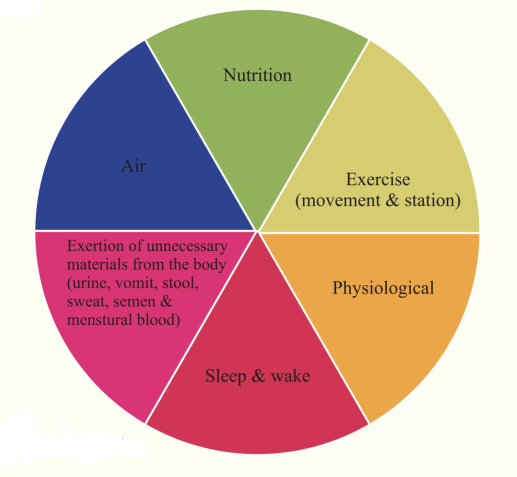
figure 1: There were six principles for health in Persian medicine called “Sette Zaroorieh”
2.Helping nature to help the body avoid harmful agents on the inside or outside.
Therefore, in PM, it is believed that Tabiat (Nature) is the main controller of body health; and physicians should help it to keep the body healthy and also to restore health in case of diseases. There are too many books on Persian medicine and drugs, both simple drugs (herbs, minerals and animals) and formulations (compound drugs). They can be categorized as below:
-Books on simple drugs: They mostly present simple drugs (herbs, minerals and animals) as monographs. They are categorized as the ones that only describe simple drugs to identify and also the ones that describe their pharmacology and therapeutic issues.
-Books on formulations: These books are Persian pharmacopeias, called Qarabadins. In these books, all aspects related to formulations and dosage forms are described.
-Special pharmaceutical books: They are mostly treaties and books on a special subject in pharmacy, for example a book on opium or a book on cardiologic drugs.
-Chapters in comprehensive medical books: In the main Persian medicine reference books like the Canon of Medicine (al-Qanun fi al-Teb) ox Liber Continent (a/ Havi), there are some chapters or parts on simple and compound medicines. Also, in most medical texts, drugs for the treatment of diseases are mentioned.
Affairs related to the nature “Umoor-e-Tabee-e-yeh”
As mentionedbefore, normal functioning andbalance ofthehuman body is based on the 7 factors of
“Umoor-e-Tabee-e-yeh”.
1.Arkan
In Persian medicine, it is believed that all creatures consist of four main substances, called the four elements. They include fire, air, water and earth. Of course, the basis of these elements is based on philosophy and they are different from the actual fire, air, water, and earth available to us, but since the characteristics of each of them are similar to the actual one, they are named in this way. Our body consists of all these elements, but the amount of each is not equal to the other. For example, there may be more fire in your body than water, earth and air, and, in your friend's body, there may be more water than fire, earth and air. This point causes individual differences in people (personalized medicine). For example, some people are brave and some are cowards; some have a strong memory and some are forgetful; some people get skin rash by eating a small amount of dates and others easily eat plenty of dates and have no problems. In Persian medicine, the causes of such individual differences are clearly explained based on "Arkan" and “mizaj\ Each of the Arkan (four elements) has certain functions and characteristics on which the “Mizaj” (temperament) is based.
* Fire: The nature of the fire is hot and dry.
Fire generates agility, rapid penetration, and lightness, and it lowers the coldness. Objects with more fire element in their structure are more agile, faster and more intrusive than others. Having more of the fire element, the person also acts faster and more agile than others.
* Air: The nature of air is hot and moist. When water is heated, it turns into steam. The steamed water has a higher energy level than water itself, because we need to consume energy to convert water to steam, so the air is warmer than water. The air is plastic and flexible, and its role is to create lightness and softness. It also makes porosity and distance between the components of substances. Those who have more air element in their body, also have larger bones than others, because the air has created distance between their bone particles.
Note that in Persian medicine, moisture does not mean immersion in water, but it means flexibility and plasticity.
* Water: The nature of water is cold and moist. It creates plasticity and flexibility in objects. Objects with more water element are more fluid and flexible than others. Having more water, the person is more flexible in dealing with issues.
* Earth: The nature of earth is cold and dry. Earth creates stability in objects. Having more earth element in the body, the person forgets memories later than others. In general, if any of these elements exists appropriately in the body composition, the organs will be able to perform their proper function.
2.Mizaj
“Mizaj” (temperament) is a quality which is a consequence of mutual interactions of the four contradictory primary qualities (hotness, coldness, moisture, dryness) residing within the elements. These elements are so meticulously intermixed with each other that they lie in a very intimate relationship to one another. Their opposite powers intermittently conquer and are conquered until a state of balance is reached that is uniform throughout the whole. This result is called the temperament “Mizaj”. In other words, Mizaj means the dominant quality of the compound object. Mizaj is one of the most important canons of the Persian medicine system. It has an important function in maintaining the ideal healthy state of an individual.
3.Akhlat
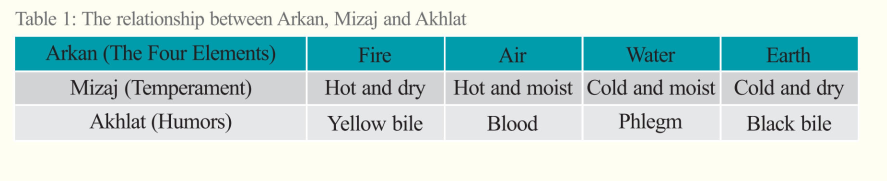
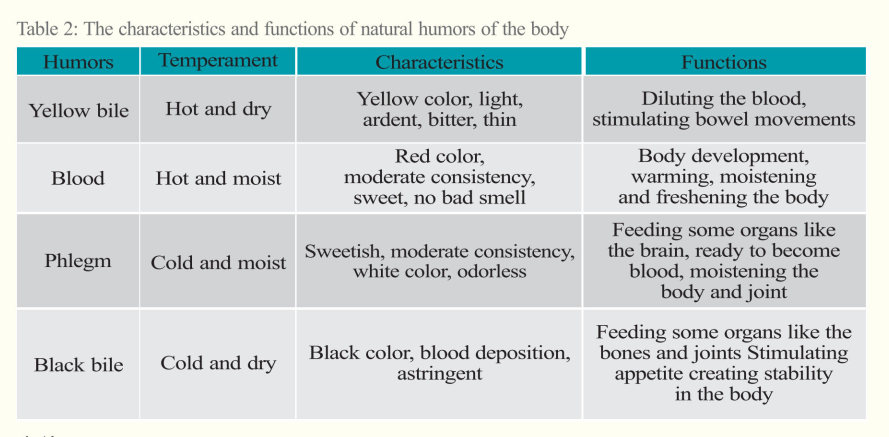
“Akhlat" is the plural of “Khelt” (humor). In the PM viewpoint, the food we eat after digestion in the stomach and liver is divided into four major groups of fluids: Yellow bile, blood, phlegm and black bile. Each of these is called humor. Humors also have their own temperament. Blood is hot and moist, phlegm is cold and moist, yellow bile is hot and dry, and black bile is cold and dry. The relationship between Arkan, Mizaj and Akhlat is shown in Table 1 .
The tissues and organs of the body are formed from humors. In PM, it is believed that digestion of food and its transformation into body tissues occurs during the four digestive stages: The first digestion is in the stomach; the second is in the liver, the third digestion is in the vessels, and the fourth digestion happens in the tissue. The waste material from each of these four stages, in some way, is excreted from the body. The waste materials derived from the first digestion is excreted through the stool, those of the second digestion exit the body through urine, and the third and fourth digestion waste material are excreted through sweat, pus, hair, nails, discharge of the ears, nose, etc. The effects and functions of humors are controlled by Tabiat (Nature). Tabiat perfectly knows that at a certain time, which of the humors and how much of that humor should exist in a certain part of the body, and how it should work. Thus, in each individual, every part of the body has a unique natural combination of these humors, and, when they are in balance, the body is healthy. If they became imbalanced or unhealthy, illness is resulted. Because this balance is different for every person, it is necessary for the physician to determine the patient's normal humoral condition before he/she could assess the changes that caused the illness. The characteristics and functions of natural humors of the body are shown in Table 2
4.A'za
“A'za” is the plural of “Ozv” which means organ. Organs are composed of humors. They are divided into two groups of simple and compound organs. Simple organ: The organ whose components are the same. These organs include bone, cartilage, chord, ligament, nerve, artery, vein, membrane, skin, fat, muscle, hair and nails.
Compound organ: The organs of the body which are composed of simple organs, such as eye, ear, hand, etc.
In terms of application, the organs are categorized as follows:
•Chief organs ( Raiesehy ) : Damage to them is harmful for human survival or reproduction, thus they are very important and vital.
Chief organs are divided into two groups:
- Important for survival: Heart, brain and liver
- Important for reproduction: Testis and ovary
•Non-chief organs (Gheire- Raiesehy). These organs are divided into two groups:
- Servant of chief organs (khadem-al-Raieseh): Each of the chief organs has a servant that delivers its power to the rest of the organs. These servant organs are:
-Arteries: Servant of the heart
-Veins: Servant of the liver
-Nerves: Servant of the brain
-Seminiferous tubules: Servant of the testis
-Fallopian tube: Servant of the ovaries
- Non-servant of chief organs (Gheire-khadem-al- Raieseh):
-Subordinate organs (Maruosehf): Kidney, stomach, spleen, lung
-Non-Subordinate organs (Gheire- Marouseh): Bones and cartilages
Temperament of the organs:
Each organ of the body has its own temperament, which is appropriate to its function.
•Hot tempered organs (respectively from the warmest to the most temperate):
Heart, liver, lung, muscle, spleen, kidney, arteries, veins, skin of the hand palm.
•Cold tempered organs (respectively from the coldest to the most temperate):
Fat, hair, bone, cartilage, chord, ligament, membrane, nerve, spinal cord, brain, skin.
•Moist tempered organs (respectively from the wettest to the most temperate):
Fat, brain, spinal cord, breast tissue, testis tissue, lung, liver, spleen, kidney, muscle, skin.
•Dry tempered organs (respectively from the driest to the most temperate):
Hair and nail, bone, cartilage, ligament, chord, membrane, arteries, veins, motor nerve, heart, sensory nerve, skin.
5.Arwah
“Arwah ” is plural of “Ruh” (spirit) which is a very soft and ethereal physical body composed of steam aroused from the good and fine part of normal humors. The spirit is gentle, smooth, and moving. It is worth noting that “Rooh ” in Persian medicine is the medical spirit that is in the body and discussed in the natural sciences and differs from the immaterial soul that is discussed in theology. There are three types of medical spirit:
1) Vital spirit (Rooh-e- Hayvani) that is in the heart and spreads by the blood in the arteries throughout
the body.
2) Natural spirit (Rooh-e-Tabiee) that is in the liver and promotes the growth and development of the
body.
3) Sensual spirit (Rooh-e-Nafsani) that is in the brain and involved in nervous system functions and
mental-psychological phenomenon.
In a healthy person, Arwah are under the strict control of Tabiat. In the other words, Tabiat manages Amah in such a way that everything goes well for the health of the body.
6.Qova
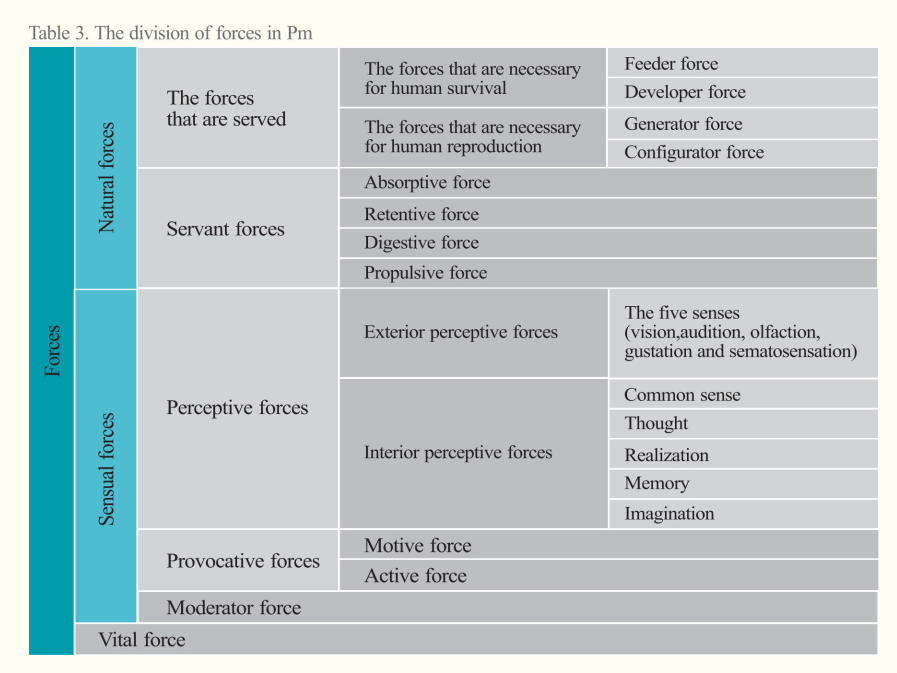
“Qova” is the plural of“Qoveh” and means the forces and faculties that cause interactions in the body. There are three types of forces in the body:
1) Vital forces (Qovaye- Hayvani) that create movement, energy and vital functions of the body. They
are also the source of feeling scared or angry. In other words, the vital force freshens the body to receive the natural and sensual spirits.
2) Natural forces (Qovaye-Tabiee) that perform the nourishment of the tissues and organs.
3) Sensual forces(Qovaye-Nafsani) that make sense, movement, and the ability to judge and decide.
Natural and sensual forces are subdivided into specific categories as follows: Natural forces (Qovaye-Tabiee)'.
7.Afal
“Afal” means body functions as a result of the interaction of forces. Afal are divided into two parts:
•Single functions (Afal-e-Mofrad): Functions that are performed with one force, such as absorption or repulsion.
•Compound functions (Afal-e-Morakkab): Functions that are performed with two or more forces, such as appetite, which comes from absorptive force and perceptive force.
The purpose of all natural affairs (Umoor-e-Tabee-e-yeh) is to perform body functions completely and correctly. In other words, natural affairs are like an interconnected chain in which the integrity and balance of all its parts are necessary to achieve a proper function. The cause of an impairment of function or the occurrence of any disorder in human health can be explained by a review of this chain.
For more information, please download:
01-International view to traditional medicine in healthcare system
02- Persian medicine: history, theory and principles of treatment
03- Official and governmental document and structures to support traditional medicine in Iran
04- Schools of Persian medicine and associated departments at university
- Tehran University of Medical Sciences (TUMS)
- Shaid Beheshti University of Medical Sciences (sbmu)
- Iran University of Medical Sciences (iums)
- Mashhad University of Medical Sciences (mums)
- Kerman University of Medical Sciences (kmu)
- Qom University of Medical Sciences (muq)
05-Research and research centers in Persian medicine
06- Persian medicine and covid-19
07- Integration of Persian medicine services into health houses network in rural areas
08- Persian medicine festival
09- the selected unique concepts in Persian medicine (below image)

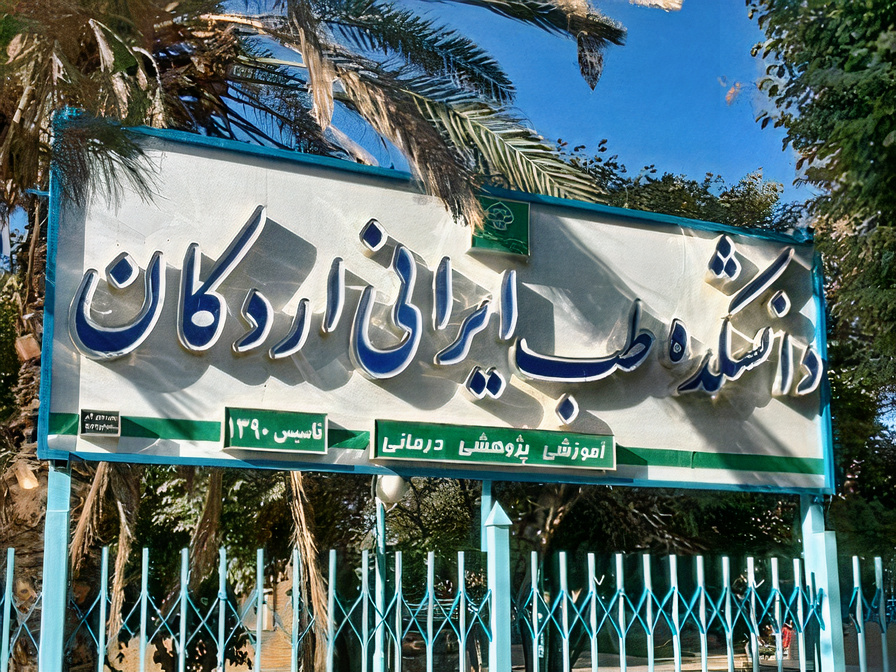
Ardakan University of Medical Sciences, Yazd
Establishment of the Ardakan Faculty of Traditional Medicine
The establishment of the Ardakan Faculty of Traditional Medicine, affiliated with Shahid Sadoughi University of Medical Sciences in Yazd, was definitively approved following extensive and effective follow-ups by relevant officials and the esteemed representative of Ardakan County on April 26, 2011, during the 211th session of the Council for the Expansion of Medical Sciences Universities. After the final vote regarding the establishment of the faculty, the executive operations for its main building commenced. The Ardakan Faculty of Traditional Medicine is located on the former site of Ghaem Hospital. The main building of the faculty comprises several different sections.
The first section includes the administrative building complex, which consists of the Dean's Office, Vice Deanship for Education, Vice Deanship for Research, Personnel Office, Financial Affairs Office, Education Experts, Research Experts, IT Department, Protective Services Unit, and the Department Head's Office.
The second section of this complex is the building designated for the faculty clinic, which includes an assembly hall, educational classrooms, examination rooms, a dedicated women's examination room, a completely standard operating room for phlebotomy, a completely standard room for cupping, a dedicated massage room, patient wards, a physicians' rest area, and changing rooms.
The third section includes the faculty laboratory.
The fourth section is a special pavilion for faculty and students, designed within the faculty itself for the complete comfort and convenience of the staff of this complex.
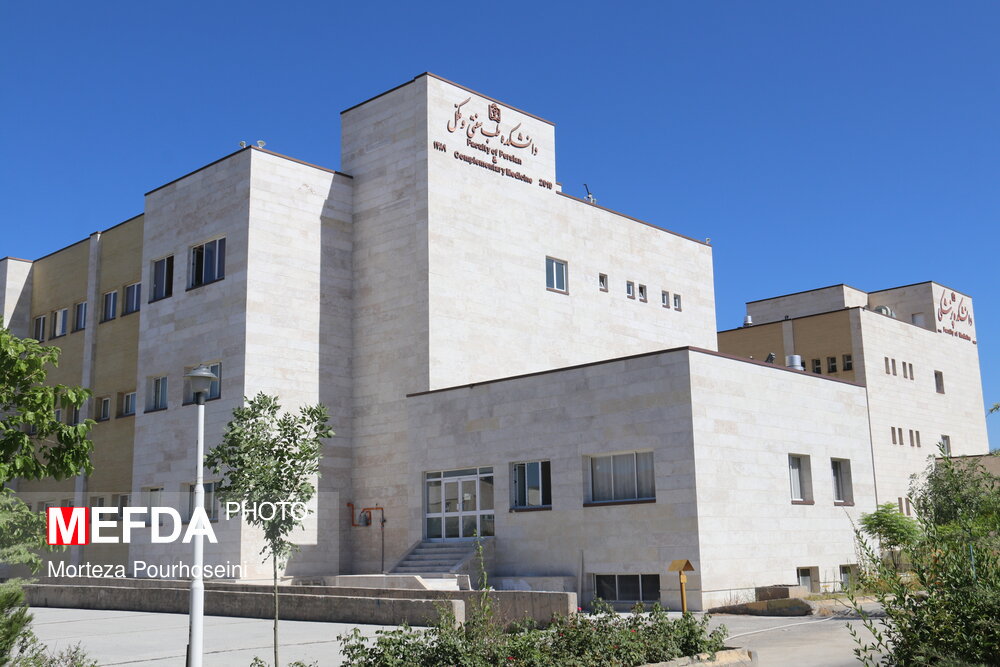
Mashhad University of Medical Sciences
History and Development of Persian and Complementary Medicine Education at Mashhad University of Medical Sciences
The Ministry of Health and Medical Education finally approved the educational program for the Master of Science (MSc) course in Traditional Persian Medicine in March 2006. Student admissions began in September 2007, with over 400 applicants competing for places. Initially, only four universities—Tehran University of Medical Sciences, Iran University of Medical Sciences, Shahid Beheshti University of Medical Sciences, and Shahed University—were authorized to admit students. A total of 24 students were accepted in 2007, and their studies commenced jointly at Tehran University of Medical Sciences.
The second round of admissions for the Master's degree took place in September 2008. From February 2009, the academic level of this field was upgraded from a Master's degree to a specialized doctorate (PhD).
The Persian Medicine Department at Mashhad University of Medical Sciences was established in 2009 following a resolution by the University Council. In August 2010, the Ministry issued a permit to admit four students. In 2010, the University Council communicated the resolution to establish the Faculty of Traditional Medicine. Each year, a number of interested candidates were admitted to the PhD program in Traditional Medicine at this faculty. By the end of 2020, thirteen cohorts of students had been admitted.
In 2020, the first cohort of students (6 individuals) was admitted to the specialized doctorate program in Acupuncture, and their studies commenced under the auspices of the Department of Chinese and Complementary Medicine.
The Faculty of Persian and Complementary Medicine currently comprises three educational departments: the Department of Persian Medicine, the Department of Chinese and Complementary Medicine, and the Department of Pharmaceutical Sciences in Persian Medicine.
Initially, until 2012, the Faculty of Persian and Complementary Medicine was located within the School of Health. Subsequently, it moved to the Milad Infertility Center, located at the end of Akhound Khorasani Street. In 2017, it was relocated to a part of the second floor of the School of Medicine, situated on the campus shared by Mashhad University of Medical Sciences and Ferdowsi University.
The total number of admitted students and graduates of the specialized doctorate program in Persian Medicine at the Faculty of Traditional Medicine, Mashhad University of Medical Sciences, by the end of 2020, was 80 and 54, respectively.
It is noteworthy that in 2017, based on an announcement by the Ministry, the word "Traditional" was removed from the suffix of Traditional Medicine departments and faculties. Consequently, the faculty's name was changed from the Faculty of Traditional Medicine to the Faculty of Persian and Complementary Medicine.
The number of course units for the specialized doctorate (PhD) program includes 28 compulsory core units, 2 elective non-core units, and 20 thesis units. In addition to these, with the approval of the University's Graduate Studies Council, up to 16 units from other courses, designated as deficiency or remedial courses, may be added to the total program units. The total number of deficiency and remedial units—of which 14 are currently offered and taught at this faculty—is also added to the total program units. The total program units will be delivered over two phases, educational and research, in accordance with the regulations of the specialized doctorate program. The educational phase, comprising coursework, is delivered over four semesters. Subsequently, upon the student passing the comprehensive examination, the research phase, which involves conducting thesis work, begins and typically takes about two years to complete.
The specialized doctorate program in Acupuncture also includes compulsory courses (22 units), elective courses (4 units), deficiency and remedial courses (5 units), and a 20-unit thesis. The curriculum for the aforementioned programs has been uploaded in the respective departments' sections.
The Central Clinic for Persian Medicine and Acupuncture is located at Imam Reza (AS) Hospital. In addition to these two clinics, which also serve an educational role, six health institutes (wellness centers) had been established by the end of 2020 in collaboration with the non-governmental sector across the city, operating under the faculty's supervision.
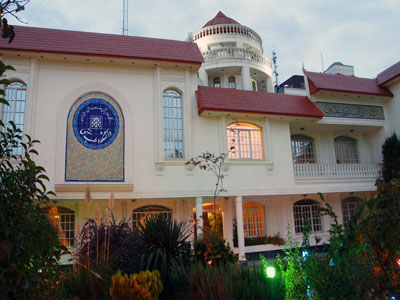
Tehran University of Medical Sciences
The history of using plants and natural remedies dates back to the beginning of human creation. To alleviate their sufferings, humanity has always relied on the most important tool at their disposal: materials found in nature. This trend continues even today, despite all technological advancements. The peak of human knowledge in research and the subsequent development of powerful chemical drugs led to a period of neglect regarding medicinal plants and traditional medicine. However, the emergence of severe side effects from chemical drugs and the spread of hard-to-treat diseases such as autoimmune disorders led people to turn once again to other therapeutic schools. The importance of this issue was not lost on the World Health Organization, which approved a protocol for organizing complementary and alternative medicine in 2000.
In our country, as traditional medicine, herbal medicines, and complementary medicine are terms that have had an ambiguous and undefined presence in our health system for years, a need for their organization was felt. On the other hand, following the guidelines of the World Health Organization seemed inevitable in the course of global progress. Therefore, the groundwork for launching and approving the field of Traditional Medicine was laid at the Ministry of Health in 2006. Four universities—Tehran University of Medical Sciences, Shahid Beheshti University of Medical Sciences, Iran University of Medical Sciences, and Shahed University—announced their readiness to admit students. With the support of the President of Tehran University of Medical Sciences, Dr. Larijani, the first Faculty of Traditional Medicine in Iran was established at Tehran University of Medical Sciences in 2007. This event became a golden leaf in history, which, according to many experts, granted permission for the thoughts of Avicennas and Razeses to enter medical universities after many years
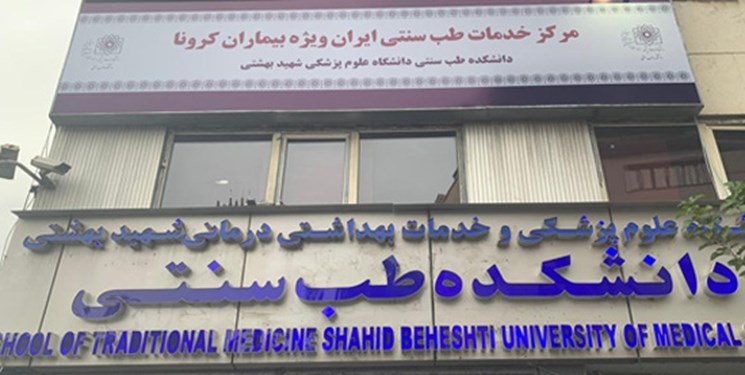
Shahid Beheshti University of Medical Sciences
Shahid Beheshti University of Medical Sciences - Faculty of Traditional Medicine
In 2008, the Faculty of Traditional Medicine at Shahid Beheshti University of Medical Sciences, consisting of three educational departments—Traditional Pharmacy, Traditional Medicine, and Medical Ethics—officially commenced its activities after obtaining approval from the Council for the Expansion of the Ministry of Health and Medical Education (Approval No. 405702/A, dated November 1, 2009). Subsequently, the organizational chart of the faculty, after undergoing the legal procedures within the university and approval by the Ministry of Health and Medical Education, was officially communicated by the head of the Center for Management and Administrative Development of the Ministry in letter No. 212/1789/D, dated December 20, 2011.
Department of Traditional Pharmacy: This department officially began its activities on February 26, 2008, through the diligent efforts of the late esteemed Professor Dr. Farzaneh Naghibi and obtaining approval from the Council for the Expansion of the Ministry of Health and Medical Education. The management of this department was undertaken by the late Professor Dr. Naghibi from its establishment until her passing. This department has four educational sections: Pharmacopoeia (Qarabadin), Materia Medica (Mofradat) and Natural Products, Processing and Industrial Pharmacy, Pharmacology and Properties, and an Educational/Research Pharmacy for Natural Products.
Department of Traditional Medicine: This department officially began its activities on November 1, 2008, after obtaining a license from the Supreme Council for the Expansion of the Ministry of Health and Medical Education. This department has four sections: Internal Medicine, Gynecology, Neurology and Psychiatry, and Health Preservation (Hefz al-Seheh), as well as a Traditional Medicine health institute (wellness center) named after Dr. Seyed Nima Shariat Panahi. In the near future, this department will establish additional health institutes for training residents and conducting research projects.
Department of Medical Ethics: This department officially began its activities on July 4, 2008, after obtaining a license from the Supreme Council for the Expansion of the Ministry of Health and Medical Education.
Research Center for Traditional Medicine and Materia Medica: This center was established in 2002 with the approval of the Council for the Expansion of the Ministry of Health and Medical Education. The center is active in the fields of Traditional Medicine, Traditional Pharmacy, Materia Medica, Ethnobotany, and the revival of ancient Persian medical texts.
